Beyond Watching: The Age of Active Learning
Active Conversations: Why Speaking is Better than Watching
Most digital learning today has a major flaw: it’s a one-way street. Whether it’s a pre-recorded video or a colorful animation, the student is often just a passive spectator. They are watching, but they aren't necessarily "doing." At SpeakMonk.ai, we believe that for a child to truly learn, they must participate.
Breaking the "Passive" Cycle
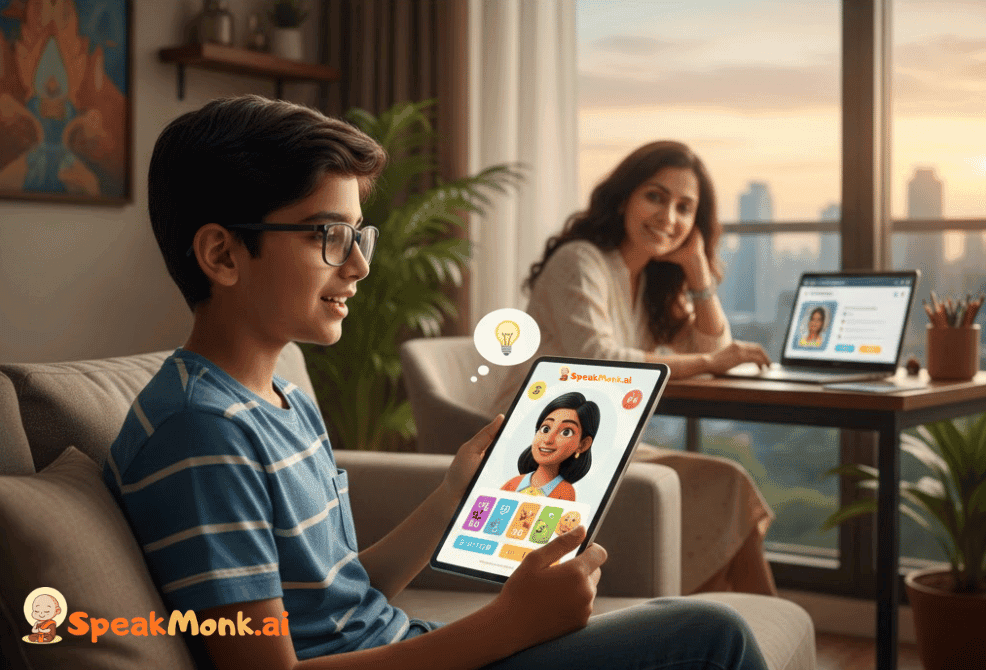
We turn the screen from a static window into a two-way conversation. Instead of a child sitting silently in front of a video, our AI Teacher starts a live dialogue. The lesson only progresses when the student speaks, responds, and interacts. This ensures the brain stays in "active mode" rather than "entertainment mode."
Imagine a student learning about fractions: instead of watching a teacher draw on a board, they participate in our "Pakora Challenge." They "eat" the snacks on screen, count the remains, and explain their logic back to the AI Teacher.
Our Interactive Learning Toolset
- Real-Time AI Voice Calls: A 1-on-1 conversational experience where the student must speak and respond, ensuring they are mentally engaged throughout the session.
- Human-in-the-Loop Oversight: While the AI teaches, a Human Mentor monitors the progress to verify the student is actually speaking and understanding the logic.
- Proactive Accountability: Unlike passive apps, we stay in touch. If a child misses a class, our mentors reach out to parents to ensure the learning path stays on track.
"By replacing passive watching with active speaking, we move beyond simple memorization to create real, lasting mastery of any subject—from Math to Robotics."
The "Accountability" Outcome
Learning is most effective when technology is backed by human responsibility. At SpeakMonk, we don't just provide content; we provide a supervised environment. We adjust lessons according to the kid’s specific needs, making sure they never feel left behind.
We ensure that every minute spent on the app is a minute of active discovery. We don't just show the student the world; we ask them to describe it.