ਇਹ ਲੇਖ ਅਜੇ ਪੰਜਾਬੀ ਵਿੱਚ ਉਪਲਬਧ ਨਹੀਂ। ਅੰਗਰੇਜ਼ੀ ਸੰਸਕਰਣ ਦਿਖਾਇਆ ਜਾ ਰਿਹਾ ਹੈ।
Coding, robotics and AI can't be taught like Maths. Here's what that means for your school
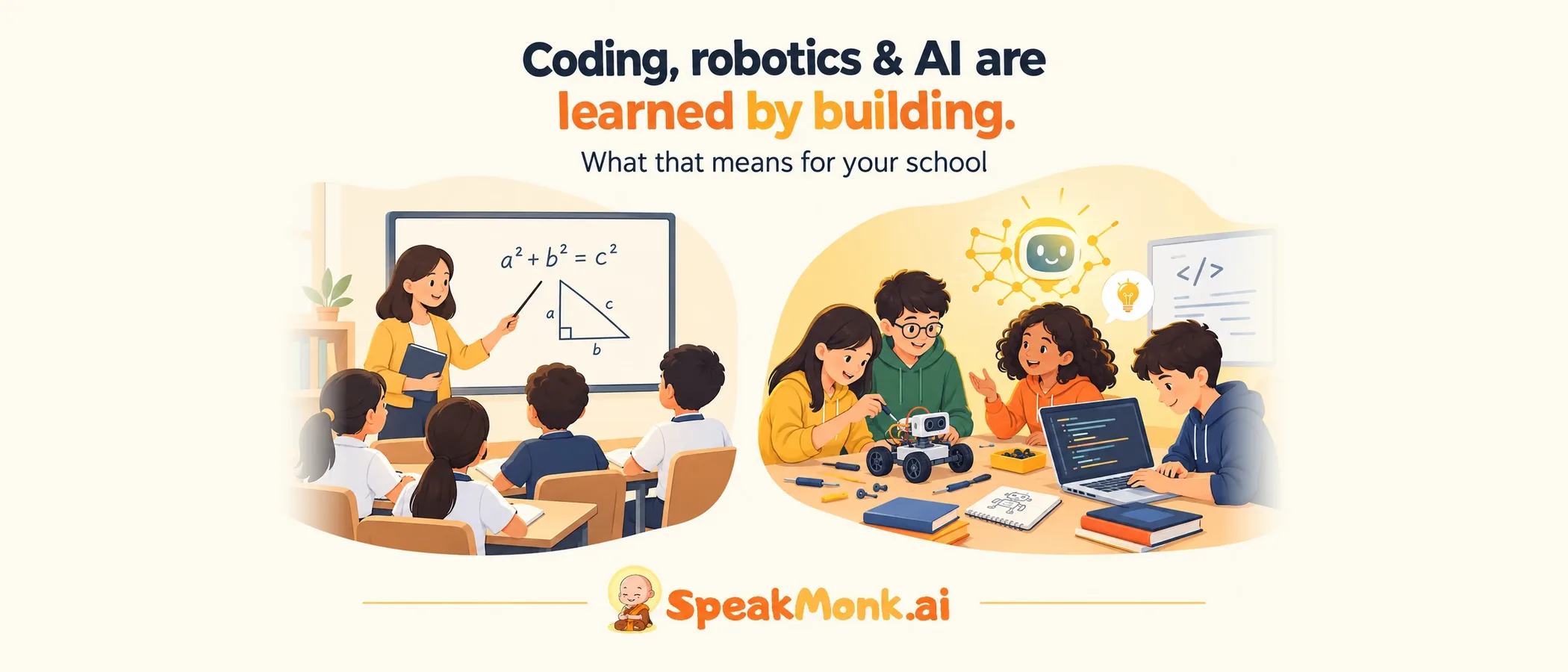
When we meet principals, one question comes up more than any other:
"We already have a coding teacher, and our Maths and Science teachers are excellent. Why would we need SpeakMonk?"
It's a fair question, and the honest answer starts with this: keep them. SpeakMonk isn't built to replace a teacher. But to see where it helps, you have to start with something most timetables ignore: coding, robotics and AI are not the same kind of subject as Maths and Science.
Maths and Science are textbook subjects
Maths and Science follow a textbook, chapter by chapter, in a clear order. A proficient teacher explains the idea, the whole class practises the same kind of problem together, and the teacher can tell from the board and the notebooks how the room is doing. One good teacher can carry thirty students through a chapter, and most schools already have those teachers.
Coding, robotics and AI are learned by building
In skills subjects the explanation is the small part. The learning happens afterwards, when each student writes a program, runs it, watches it fail and works out why. A robot that turns the wrong way or stops too late teaches more than any slide, but only to the student who is fixing it.
That changes how the subject has to be taught:
- Every student is stuck somewhere different. In a Maths class, most students are on the same problem. In a coding lab, thirty students have thirty different programs and thirty different bugs.
- Help has to be inside their own work. An explanation on the board doesn't fix a missing colon on line 5, or a sensor reading compared the wrong way. Someone has to read that student's code.
- Waiting ends the lesson. A student who waits ten minutes for help often stops trying. By the time the teacher reaches them, the period is nearly over.
- Watching isn't learning. With shared kits and demos, a few students build while most watch. In a skills subject, the students who only watched haven't really had the lesson.
- The subject moves fast, and specialists are rare. Teachers who are truly proficient in AI, Python and robotics are hard to find and hard to keep.
So a skills lab is one-on-one work by nature. That's why a teacher who runs an excellent Maths class can't run a coding lab the same way, and why even a skilled specialist can't be at thirty screens at once.
What SpeakMonk does in a skills lab
SpeakMonk sits beside every student while they build.
- It teaches the idea out loud, one step at a time, and checks that the student can explain it back before they start building.
- It reads each student's own code. When something breaks, it leaves a hint as a comment in their code, straight away. It doesn't hand over the answer: a full solution comes only after the student has tried twice, and only if they ask.
- Every student programs a robot. Each student has a virtual robot in the browser, with walls, a distance sensor, line and light sensors, LEDs and a buzzer, so nobody waits for a turn. When your lab has robot boards, the same code flashes to the real robot over USB.
- Practice is built from the chapter they just finished, so building follows straight on from learning.
If you already have a specialist teacher
You're ahead of most schools, and SpeakMonk makes your specialist go further. They stop running from desk to desk fixing the same error, because every student already has help inside their own code. Their time goes where a person matters most: projects, discussion, the student racing ahead and the one who's quietly lost.
The course also stops resting on one person. If your specialist is on leave or moves on, the lessons, practice and reports stay in place, and whoever steps in can see exactly where each student stands.
If you don't have one yet
Then SpeakMonk does the most for you. It teaches AI, coding and robotics the way a specialist would, from Class 5, while one of your existing teachers runs the room and reads the reports. There's no specialist to find and hire before your students can start.
Need a subject we don't list, such as AI and computational thinking, cybersecurity basics or your own syllabus? We build the course for your school. Subject experts review every lesson, and the course appears in your school's own catalogue, only for your students.
In Maths and Science, SpeakMonk supports your teachers
Here the job is different. Your school already has proficient Maths and Science teachers, so SpeakMonk isn't the specialist. It makes the time around class count.
- Students learn the chapter before class. NCERT chapters for Classes 5 to 8, in the book's order, taught out loud by the AI teacher. Class time goes to the harder questions instead of first explanations.
- Doubts get cleared at home. A student stuck at 8 pm asks out loud and gets an answer in conversation, without waiting for tomorrow's class or extra tuition.
- It finds the gap behind the mistake. When a student gets something wrong, SpeakMonk looks for the idea underneath that they haven't understood yet, and clears that first.
- Shy students ask. Children ask the questions they would never ask in front of thirty classmates.
- Your teacher walks in knowing who's stuck. Every chapter a student finishes becomes a report on the teacher dashboard, and the whole class rolls up into one summary.
Find out who actually understood
NEP 2020 asks schools to assess what students can do, not what they've memorised. Written tests and MCQs don't always show that. A student can guess an option, or recite an answer they don't understand.
A SpeakMonk Socratic test is spoken. A teacher generates one for any chapter, and the student explains the idea aloud for five to ten minutes. Results come back by topic: which ideas each student understood, half-understood or got wrong. In Maths and Science, gaps show up before the exam, while there's still time to reteach. In coding, it shows who can explain the idea behind their program, not just who got it to run.
In any language your students think in
Language shouldn't decide who understands. SpeakMonk teaches and answers doubts in English, Hindi or any language the student is comfortable in. A child who thinks in their home language isn't held back by the language of the lesson.
Who does what
- Your teacher leads the room, decides what each class covers next, runs projects and discussion, and supports the students who need a person.
- SpeakMonk teaches each student one-on-one by voice, reads their code and gives hints, answers doubts at any hour, runs spoken tests, and turns all of it into reports your teacher can act on.
Built for where Indian schools are heading
SpeakMonk is built around NEP 2020 and NCF 2023's push for competency-based, hands-on learning, and it's ready for CBSE's move to bring AI and computational thinking into schools. It runs in any browser, on lab computers, tablets or phones, with nothing to install. SpeakMonk is an independent platform and is not affiliated with or endorsed by CBSE or NCERT.
See it in your own lab
The best way to judge this is with your own students. We'll show you a demo on your syllabus, then run a free lab pilot with your students and teachers, with no cost and no commitment.
Start a free lab pilot or message us on WhatsApp.
ਇਹ ਪੜ੍ਹਾਈ share ਕਰੋ