Using AI isn't learning AI. How to make AI hands-on for your students
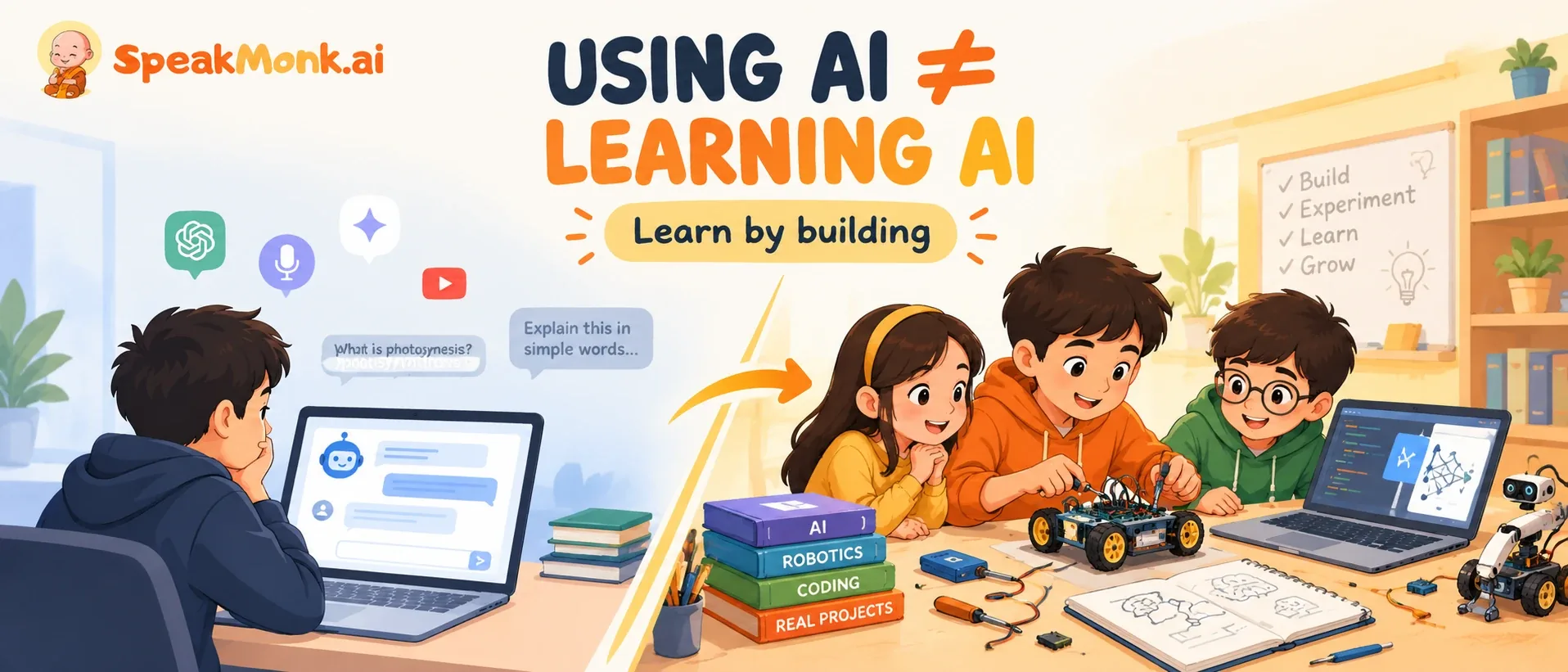
Most of your students already use AI. They ask chatbots questions, talk to voice assistants and scroll feeds that a model chose for them. It's easy to assume that means they're learning about AI.
They aren't, any more than riding in a car teaches you how an engine works. Using AI and understanding AI are different skills, and only one of them prepares students for what comes next.
With CBSE bringing AI and computational thinking into schools, the question we hear from principals has changed. It's no longer "should we teach AI?" It's "how do we teach it properly?" Our answer: the same way coding and robotics are learned, by building.
Using AI vs understanding AI
A student who understands AI can do more than type a good question into a chatbot. They know that:
- A model learns patterns from examples. It isn't told the answer; it finds a pattern in the data it was given.
- A model is only as good as its data. Too few examples, or the wrong ones, and it learns the wrong pattern.
- Models make mistakes. A confident answer isn't always a correct one, and it's worth checking.
- A rule a person writes is different from a pattern a machine learns. Both are useful, for different problems.
None of this sticks from a slide. Students believe it when they've seen their own model get something wrong and worked out why.
What hands-on AI looks like in a classroom
It starts with computational thinking
Before machines learn anything, students learn to think like a programmer: break a problem into steps, spot patterns, and write rules a computer can follow. This is where younger classes begin.
A robot that decides from its sensors
Every student programs a robot in the browser. It reads its distance, line and light sensors, and the student writes, in Python, what it should do with each reading: stop before the wall, follow the line, react to light. Students see a machine act on what it senses, and when it gets it wrong, they fix the decision themselves. When your lab has robot boards, the same code runs on the real robot over USB.
Working with data
Students collect and organise data, look for patterns in it, and ask what the data can and can't tell them. This is the raw material of every AI system, and the part most AI lessons skip.
Training a simple model
Then students train a simple model of their own on examples, test it, and see where it's wrong. They change the data, train again and watch the results change. It's the moment the difference between a rule they wrote and a pattern the machine learned becomes obvious.
Explaining it back
Building isn't the end. In a SpeakMonk Socratic test, students explain aloud what they did and why: why the model made that mistake, why the robot stopped where it did. A student who can explain it has understood it. A student who only got it to run hasn't, yet.
Why every student has to build it themselves
AI is a skills subject. Like coding and robotics, it's learned by doing, and every student gets stuck somewhere different. We wrote about why that changes how it has to be taught in Coding, robotics and AI can't be taught like Maths.
That's what SpeakMonk is built for. The AI teacher explains each idea out loud, one step at a time, and waits until the student can explain it back. When a student's code breaks, it leaves a hint as a comment in their own code instead of handing over the answer. Every student has their own robot, so nobody watches while others build. And it all works in English, Hindi or any language the student is comfortable in.
Built for your school, on the CBSE syllabus
We build the AI course for your school, following the CBSE syllabus for each class: lessons the AI teacher delivers out loud, data activities, Python practice, robot challenges and Socratic tests. Subject experts review every lesson, and the course appears in your school's own catalogue, only for your students.
Your teachers see a report for every chapter each student finishes, and one summary for the whole class, so they know who has understood and who needs help before moving on.
What your school needs
- A browser and an internet connection. Lab computers, tablets or phones, with nothing to install.
- No AI specialist to hire. SpeakMonk teaches the subject; one of your teachers runs the room and reads the reports.
- Robot boards are optional. Every student has a virtual robot from day one. If your lab has boards, the same code runs on them.
SpeakMonk is built around NEP 2020 and NCF 2023's push for competency-based, hands-on learning. It is an independent platform and is not affiliated with or endorsed by CBSE or NCERT.
See it in your own lab
The best way to judge this is with your own students. We'll show you a demo on your syllabus, then run a free lab pilot with your students and teachers, with no cost and no commitment.
Start a free lab pilot or message us on WhatsApp.
Share this read