Why Schools Traded Mastery for Efficiency
Take a look at almost any standardized test, worksheet, or digital learning platform today, and you will see the same formats: multiple-choice questions (MCQs), fill-in-the-blanks, and matching exercises.
For over a century, these formats have been the gold standard for measuring student progress. But it raises a critical question: Do educational boards rely on multiple-choice because it is the best way to learn, or simply because it is the easiest way to grade?
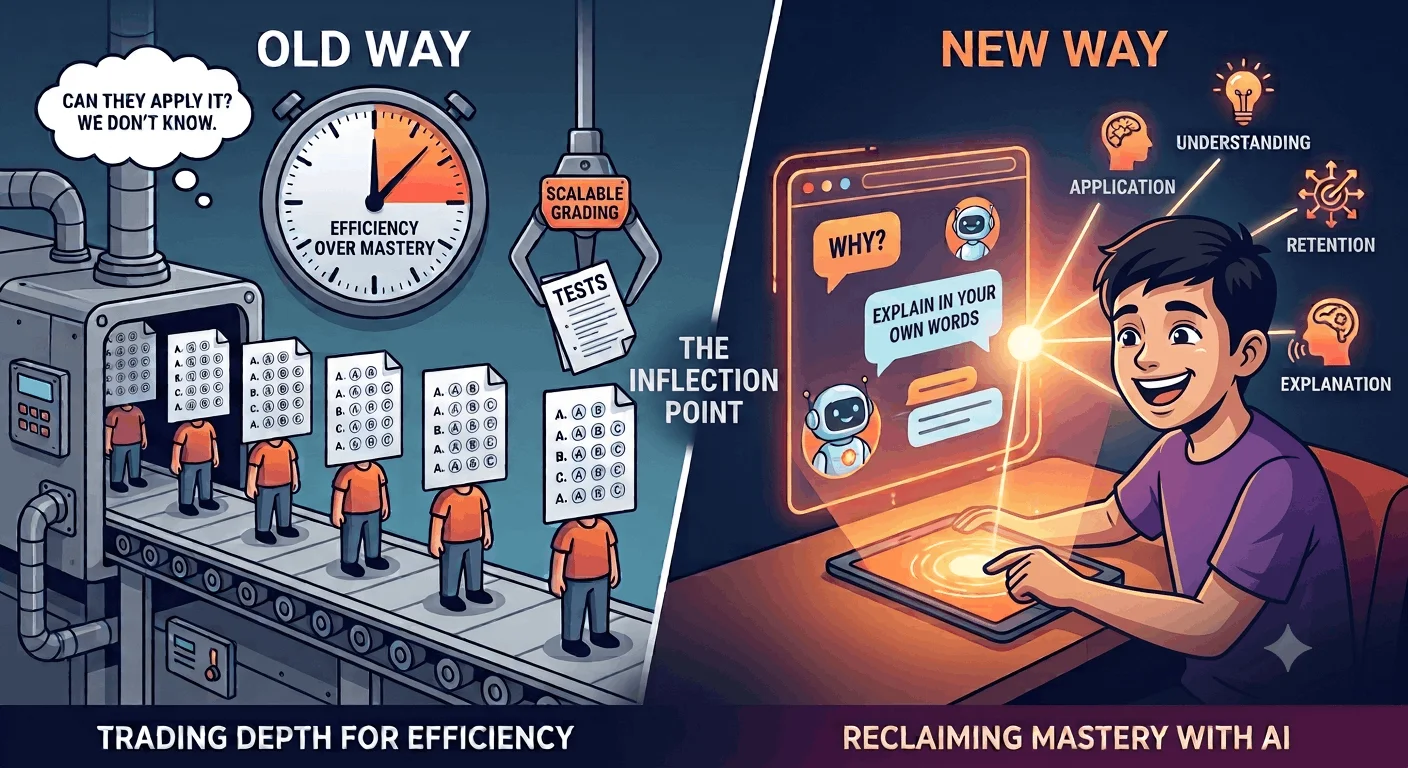
The truth is a hard pill to swallow: the modern education system traded depth of understanding for efficiency of grading. But we are finally at a technological inflection point where we no longer have to make that compromise.
The Illusion of Competence
Fill-in-the-blanks and MCQs have a legitimate place in early cognitive development. They are excellent for testing basic recall and recognition. Before a student can explain the complexities of cellular biology, they need to know the basic vocabulary.
However, the problem arises when our assessment stops there.
When a student selects "C" on a multiple-choice test, it tells us they can recognize a correct pattern. It does not tell us if they actually understand the underlying concept. This creates an Illusion of Competence. Students memorize facts just long enough to pass a test, but lack the ability to apply that knowledge in the real world.
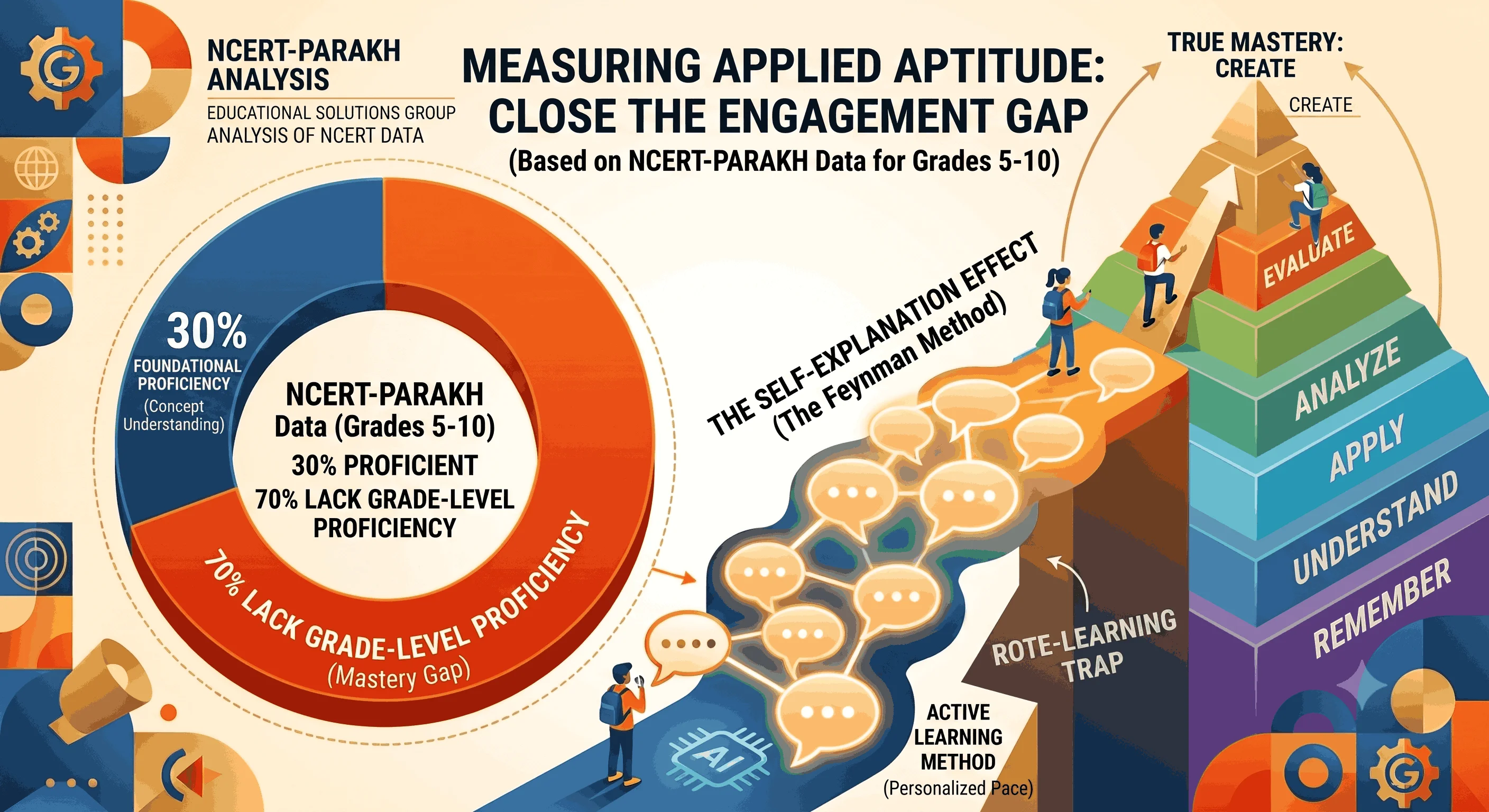
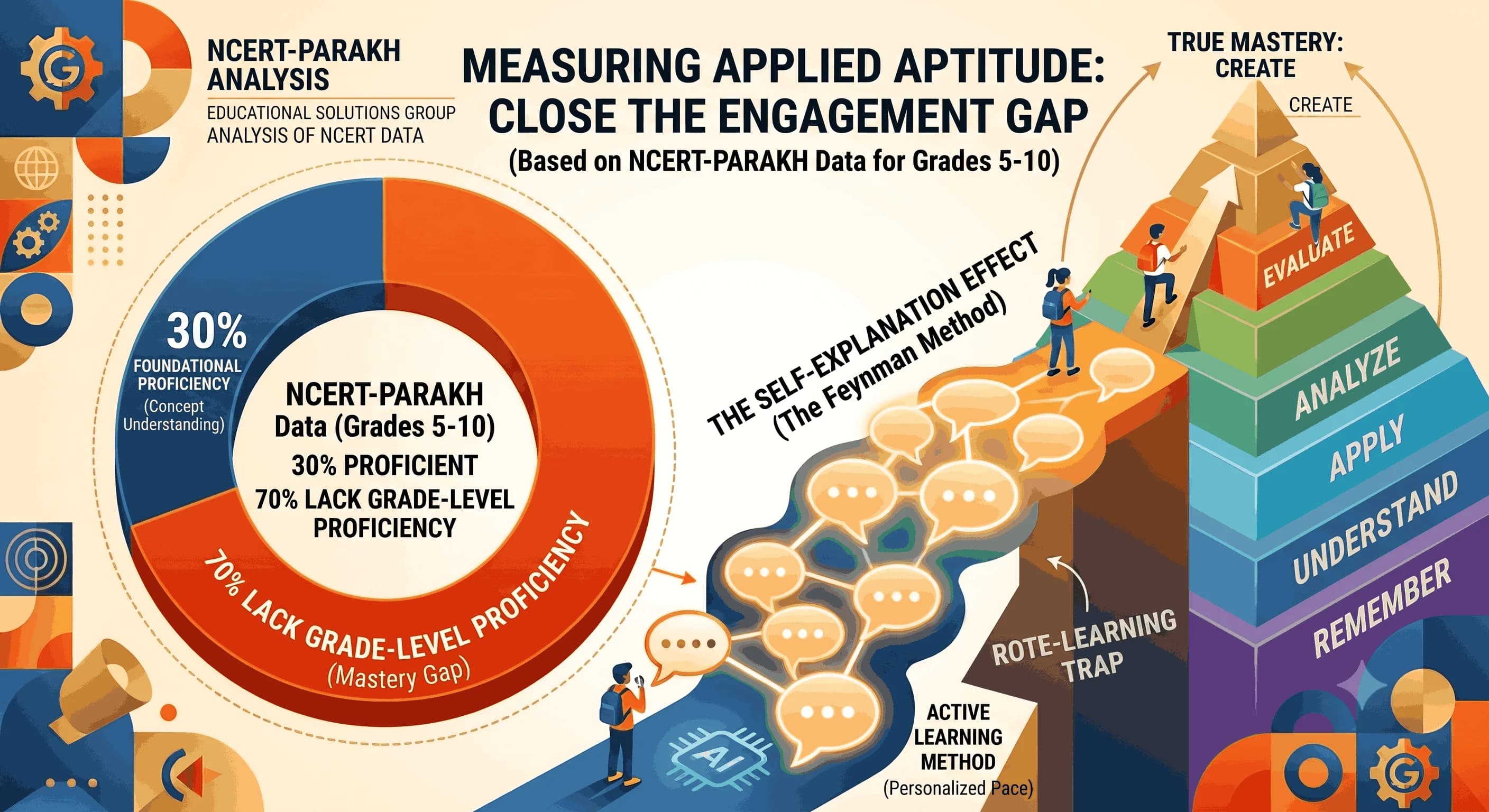
We are seeing the devastating results of this compromise in real time. According to recent data from NCERT-PARAKH, 70% of students in Grades 5–10 lack grade-level proficiency.
Students are progressing through the system by guessing or recognizing patterns on standardized tests, but they are not retaining the foundational concepts required for higher-order thinking.
In educational psychology, Bloom’s Taxonomy classifies the levels of human learning. Memorization and recall sit at the absolute bottom. True mastery, the ability to analyze, evaluate, and explain, sits at the top. Traditional assessment methods keep millions of students trapped at the bottom.
The Compromise of Scale
If we know that MCQs only test surface-level knowledge, why are they so ubiquitous?
Resource limitations.
The global education system was built on an industrial model. If an educational board needs to assess 20 million students in a single week, it is physically impossible to have human teachers sit down and conduct a 10-minute conversational interview with every child.
Historically, true 1-on-1 Socratic assessment, where a teacher asks probing questions and forces the student to explain concepts in their own words, was a luxury reserved for the ultra-wealthy. For everyone else, OMR (Optical Mark Recognition) sheets and standardized tests were the only scalable solution. A machine can grade 10,000 multiple-choice tests in minutes.
We sacrificed the quality of assessment to manage the sheer volume of students.
The Self-Explanation Effect
Decades of cognitive science research point to a better way. The Self-Explanation Effect proves that students who verbally explain steps and concepts to themselves or a tutor learn significantly deeper and retain information far longer than those who simply read text or pick answers from a list.
As the physicist Richard Feynman famously championed: You do not truly understand something unless you can explain it in your own words.
When a student is forced to articulate the “Why,” they cannot hide behind a lucky guess. They must actively synthesize their knowledge, confront their own logic gaps, and build a cohesive mental model.
Shifting the Paradigm: From Memorization to Mastery
For 100 years, the education system was blocked by a massive bottleneck: human time. Today, that bottleneck is gone.
With the advent of conversational, Socratic AI, we no longer have to rely on passive testing. We can finally give every single child the deep, personalized, 1-on-1 assessment that the system previously couldn't afford to provide.
Instead of asking a student to click a button, the next generation of EdTech forces them to speak up. AI doesn't just evaluate if the final answer is right or wrong; it assesses how the student arrived there, asking real-time follow-up questions to ensure true comprehension.
We are moving away from an era of passive observation and entering an era of active exploration. It is time to stop testing students on what they can memorize, and start empowering them by what they can explain.
At SpeakMonk.ai, we are building the Socratic AI engine that shifts students from "watching" to "thinking." By focusing on verbal reasoning and active explanation, we replace the rote-learning trap with true conceptual mastery.
Share this read